
Oakland County Arrest Records and Court Charges
An arrest record is the account of an arrest itself. It captures who made the arrest, when it happened, and the booking that follows when a person is taken to the county jail. In Oakland County, that custody side is run by the Sheriff's Office, which manages booking, intake, and the jail roster. An arrest record on its own is not proof of guilt. It only shows that police took someone into custody based on their read of the facts.
The court charges after arrest are a different record. Once police finish an investigation, they bring the case to the Prosecutor, who decides whether to file charges and what those charges should be. If the prosecutor authorizes charges, a complaint and warrant are filed with a district court, and that filing opens the charge record. Booking and jail detail live on the Oakland County inmate records page, while the full case file, pleas, and sentence live under Oakland County criminal court records.
How to Find Oakland County Arrest Records and Charges
The charge side of a case is searched through the court, not the jail. For felony cases in the Sixth Judicial Circuit Court, Court Explorer shows the charges, the register of actions, and the current status. The county confirms the portal can be searched by name or by case number and that it covers felony criminal case types. It also warns that Court Explorer is not the official record and should not be used as a background check.
- Open Court Explorer for Sixth Circuit public legal records.
- Search by the defendant name, or enter the case number if you have it.
- Open the case and read the full list of charges filed against the defendant.
- Check each charge's statute, severity level, and current status in the register of actions.
Misdemeanor charges and early felony filings often sit in a local district court instead of the Circuit Court. The statewide MiCOURT Case Search covers participating district and probate courts, with case types that vary by the court searched. For a broad criminal history rather than a single case, the Sheriff's Records Unit refers people to the Michigan State Police, and the arrest and booking side is confirmed through the jail records channels.
How Oakland County Charges Are Filed After an Arrest
The charge record begins when a prosecutor files a charging document. Between the arrest and that filing sits a review step. Police report the crime to the agency where it occurred, and after investigation they present the case to the Prosecutor's Warrants Division. Assistant prosecutors then decide whether charges are appropriate. If they are, the office authorizes a complaint and warrant to be filed with the relevant district court. Michigan uses three main charging documents, and the table below sorts them out.
| Complaint | Information | Indictment | |
|---|---|---|---|
| Filed By | Prosecutor after review | Prosecutor | Grand Jury |
| Common For | Misdemeanors and felony starts | Many felonies after bindover | Serious felonies |
| Starts | The case in district court | The case in circuit court | The case |
Note: Most Oakland County felonies begin with a complaint and warrant in a district court, then move to the Circuit Court on an information after bindover, not by grand jury indictment.
Who Files Charges in Oakland County
The Prosecutor's Warrants Division is the intake and charging engine for the county. Its role is to review police work and decide whether an arrest turns into a formal case. That decision is where an arrest record and a charge record split apart. The division also initiates extraditions and detainer actions for defendants held in other states or in federal custody.
The county describes this intake and charging function on its Indigent Defense Services pages and its prosecutor pages, which sit on opposite sides of the same case.
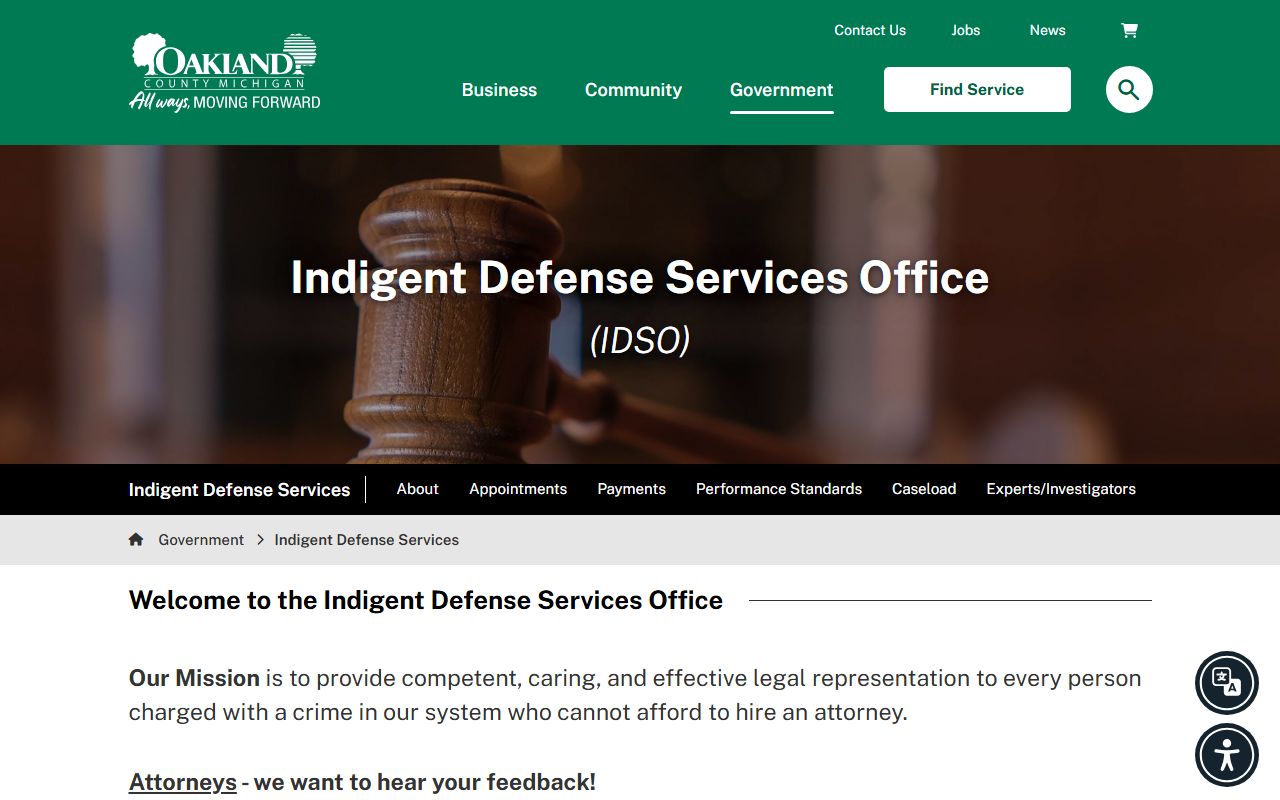
Indigent Defense Services was created in October 2021 to comply with MIDC Standard 5, so that appointed counsel is managed apart from the judiciary.
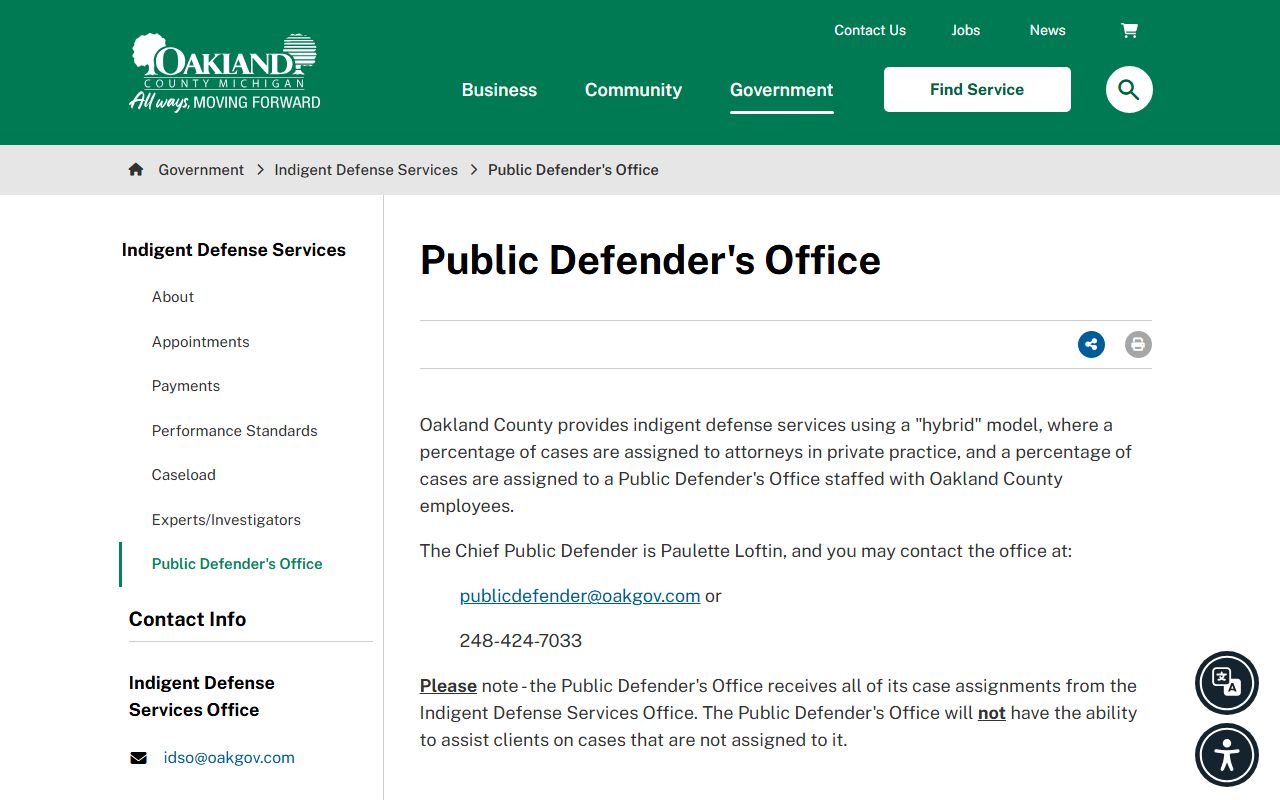
A defendant who cannot afford a lawyer may be assigned one through the Public Defender's Office, led by Chief Public Defender Paulette Loftin. That office takes only the cases assigned to it by Indigent Defense Services. Its role and limits are set out on the Public Defender's Office page.
Defense filings appear alongside the charges in the record, so a charge search often shows both the prosecution and the defense side of a case.
Oakland County Charge Status Explained
Charges rarely stay frozen as first filed. As a case moves, the prosecutor may amend, reduce, add, drop, or dismiss a charge. Reading the current status is the only way to know where a charge actually stands. A charge that looks serious at filing can end up reduced or gone by the disposition. The table below defines the status terms a searcher sees most often.
| Status | What It Means |
|---|---|
| Pending | The charge is filed and active, with no final outcome yet. |
| Amended / Reduced | The charge was changed, often to a lower offense, as the case developed. |
| Dismissed | The court dropped the charge, either with prejudice or without prejudice. |
| Nolle Prosequi | The prosecutor chose not to pursue the charge further. |
Charge vs. Conviction
A charge is an accusation, and a conviction is a finding of guilt. The two are easy to confuse in a record, but they carry very different weight. A charge only means the prosecutor believed there was enough to file. A conviction means the case reached a guilty plea or verdict. Many charges never become convictions.
| Charge | Conviction | |
|---|---|---|
| Stage | Accusation | Verdict or plea |
| Burden of Proof | Probable cause | Beyond reasonable doubt |
| Public Record | Yes | Yes |
Oakland County Charge Codes and Severity Levels
Every charge is tied to a Michigan statute, and that link sets its severity level. Michigan sorts offenses into felonies, misdemeanors, and civil infractions. A felony is the most serious and can lead to prison. A misdemeanor carries a lighter maximum, and a civil infraction is not a crime at all. One arrest can produce several separate charges, each with its own code and level.
The charge level also decides the court path. Misdemeanors are handled by the district courts from start to finish. Felonies begin in a district court for arraignment and a preliminary examination, then move to the Circuit Court after bindover. Because a single case can carry both felony and misdemeanor counts, the same record may reference more than one court. Reading the statute code beside each charge tells you which path that count is on.
Volume shapes how these charges appear in the record. The Prosecutor's District Court Division handles cases before 15 district courts and about 30 district judges, working roughly 50 dockets each week. That load spreads misdemeanor and early felony charges across many local courts, so the same defendant can have counts filed in more than one district. The Circuit Court Division carries the felony trials, including home invasion, robbery, assault, felony drunk driving, and homicide. Matching the charge code to the right division and court is the fastest way to trace a count from filing to outcome.
Note: One arrest can produce several charges at once, and each count can move, resolve, or drop on its own timeline, so always read the status beside every charge.
Sealed vs. Set Aside Charge Records
Michigan does not use the term "expunged" the way many states do. The state term is "set aside," which makes an eligible conviction nonpublic for most public searches. A sealed record is hidden by statute or court order. A set-aside conviction is retained by law enforcement but removed from ordinary public view. The comparison below shows how the two differ.
| Sealed | Set Aside | |
|---|---|---|
| Visibility | Hidden from public access | Nonpublic for most public searches |
| Law Enforcement | Limited access by rule | Retained access as allowed by statute |
| Eligibility | By statute or specific court order | Under MCL 780.621 through 780.621d |
A set-aside request runs through the court where the conviction occurred. The Michigan set-aside statute and the SCAO MC 227 form govern who qualifies and how to apply, with a separate application required for each court involved.
Statewide Charge and Criminal History Lookups
A single case search is not the same as a full criminal history. Charges filed across Michigan roll up into records held by state agencies rather than one county portal. For anything broader than a specific case, the Sheriff's Records Unit points people to the Michigan State Police. A local agency background letter from the Sheriff only covers whether a person was arrested by that office or held in the county jail.
The custody side confirms the arrest and booking detail behind a charge. The Sheriff's Corrections Records Unit handles proof-of-incarceration letters and local background letters, and its work sits beside the charge record without being part of it. Details on that office appear on the Sheriff's Records Unit page.
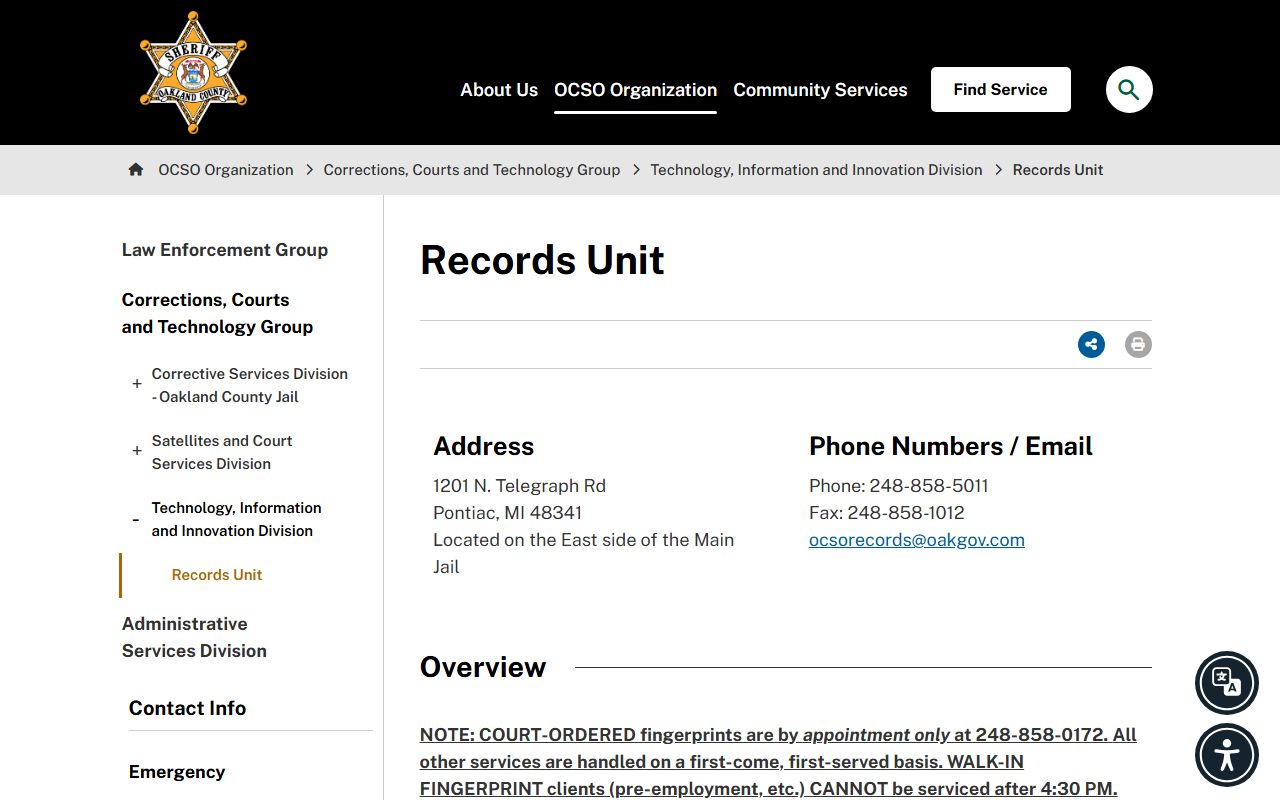
A proof-of-incarceration letter is free but requires a visit with photo identification, while a local background letter costs five dollars.
Background Check Considerations
A quick name search and a formal background check serve different needs. Court Explorer and MiCOURT can show a specific charge and its status, but neither is a certified criminal history. Employers, landlords, and licensing bodies that rely on arrest or charge data must follow the federal and state rules for regulated screening. A dropped or dismissed charge should never be read as a conviction.
Important: This site is not a consumer reporting agency under the Fair Credit Reporting Act, and its information may not be used for credit, employment, tenant, or insurance decisions.
Restricted Charge Records in Oakland County
Not every charge record is open to the public. Juvenile charges are restricted, so online access should not be assumed. Personal Protection Orders are excluded from Court Explorer, and probate mental health records are kept out of that portal too. A charge that ends in a set-aside conviction may drop out of public search entirely.
Protected identifiers are handled with care as well. Social Security numbers, financial account data, and minor identifiers are separated from public filings through the MC 97a addendum. When a charge record is restricted, the correct route is the court with proper standing or a court order. Active enforcement, such as an unresolved warrant tied to a charge, is tracked through the Sheriff and district-court warrant resources rather than the public case index.