
What Probate Covers in Oakland County
The Oakland County Probate Court decides matters tied to estates, wills, and the care of people who cannot manage their own affairs. Its caseload includes formal and informal estate proceedings, small estates, trusts, and delayed registration of foreign birth. The court also hears guardianships and conservatorships for both minors and adults, along with guardianship reviews, developmentally disabled cases, and mental health proceedings. Each case type has its own forms and its own level of public access.
Probate often begins when someone dies owning assets in their name alone, or when a family needs legal authority to care for a relative. The court appoints a personal representative to gather assets, pay valid debts, and hand out what remains. Formal proceedings involve court supervision, while informal and unsupervised proceedings move with less oversight. Small estate proceedings offer a simpler path when an estate is modest. Guardianship and conservatorship cases protect people who cannot make safe decisions about their health or money.
Probate is a distinct trial court in Michigan, separate from the Circuit Court and the district courts. In Oakland County it sits on the county government campus in Pontiac. The court keeps the official record, while an online tool offers case status for quick reference. Copies of documents come from the court itself, not from the status search.
An overview of the court, its case-type pages, and its contact details appears on the Oakland County Probate Court page.
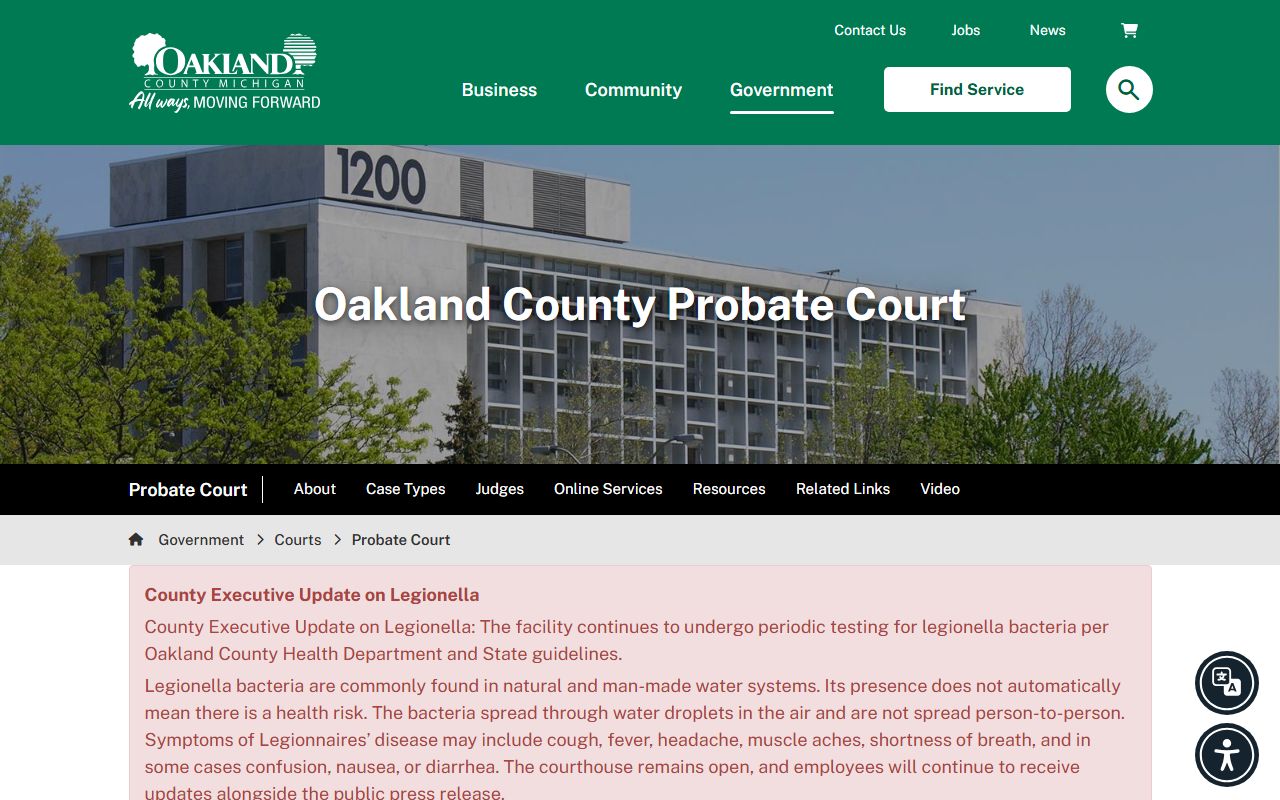
That page also carries the current e-filing notice that now governs most probate submissions.
Probate Terms Defined
Probate paperwork uses words that rarely come up in daily life. A quick reference makes case entries easier to read. The terms below appear often in Oakland County estate and guardianship files.
- Testator
- The person who made the will.
- Executor
- The person named in a will to carry out its terms and settle the estate.
- Intestate
- Dying without a valid will, which sends the estate through state distribution rules.
- Guardianship
- A court arrangement that lets one person make personal or care decisions for a minor or an incapacitated adult.
- Conservatorship
- A court arrangement that lets one person manage the money and property of someone who cannot do so alone.
How to Search Oakland County Probate Records
The main online path is Probate Access, a free tool that searches Oakland County Probate Court cases by name. It returns case status and general information, not the official record. Users must accept the terms before searching. The tool cannot be used to view or order documents, and the court warns that a name match alone does not prove identity. Case information may lag behind the courthouse file, so treat the results as a starting point.
- Open Probate Access and accept the terms of use before running a search.
- Enter the party name to find the matching case and note its case number.
- Order copies by case number through the online service, or view the public file at the court.
The name-based lookup runs through the county's Probate Access case search page.
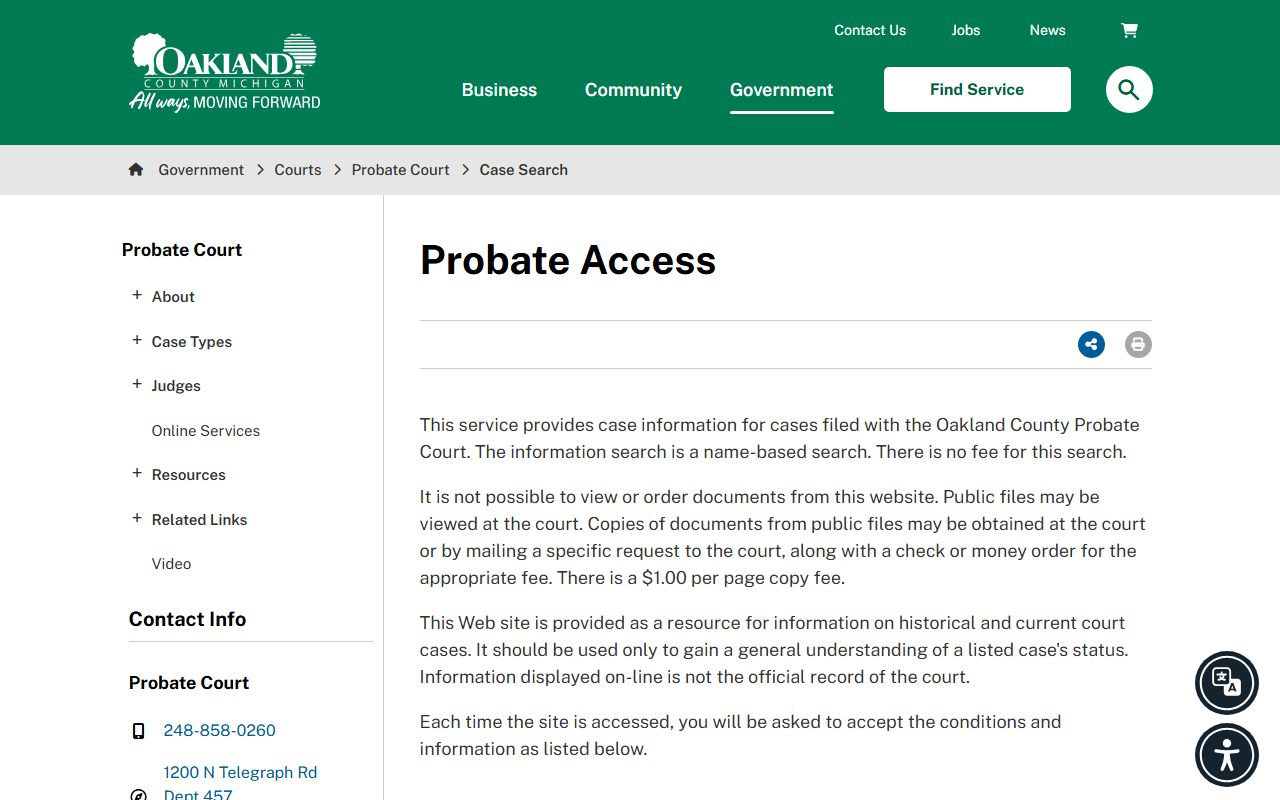
Because that page shows status only, copies of filings follow the ordering steps described below.
When the online tool is not enough, the public file can be viewed at the court in Pontiac. Copies from a public file may be obtained at the counter, or by mailing a written request with a check or money order for the correct fee. The online information reflects historical and current status, not the official record, so any certified need should go straight through the court.
Some Michigan probate cases also surface through MiCOURT Case Search, the statewide portal for participating courts. Available case categories vary by the court searched and can include probate matters. That option works best when the filing court is already known. For Oakland County, Probate Access stays the direct county tool.
Important: A name match in Probate Access is not proof of identity, and the court asks users not to take adverse action against anyone based only on a name that appears in the search.
Probate Court in Oakland County
Oakland County has one Probate Court, located with the other county court offices in Pontiac. Four judges hear its cases: Hon. Jennifer S. Callaghan, Hon. Nicole S. Huddleston, Hon. Daniel A. O'Brien, and Hon. Traci Richards. The court posts hours of Monday through Friday, 8:30 a.m. to 4:30 p.m., and by court order weapons and cutting instruments are not allowed in the building.
Oakland County Probate Court
1200 N. Telegraph Road, Department 457
Pontiac, MI 48341
248-858-0260
Monday to Friday, 8:30 a.m. to 4:30 p.m.
Note: The court warns that entering case data can be delayed, so a very new filing may not appear in the online status tool right away.
Oakland County Probate Copy Fees
The court charges a flat per-page rate for copies of public probate documents. Copies may be ordered online by case number only, requested at the counter, or mailed with a check or money order for the correct amount. Attestations, which are certified attested copies, must be ordered in person or by mail rather than online.
| Item | Amount |
|---|---|
| Copy of a public probate document | $1 per page |
| Online copy order | By case number only |
| Mailed copy request | $1 per page, by check or money order |
| Attestation (certified attested copy) | In person or by mail only |
Copy costs stay the same whether a file is old or new. Mailed requests should list the case number so staff can locate the documents quickly. The county's Probate Court online services page handles copy ordering by case number, an inventory fee calculator, and the judicial schedule lookup.
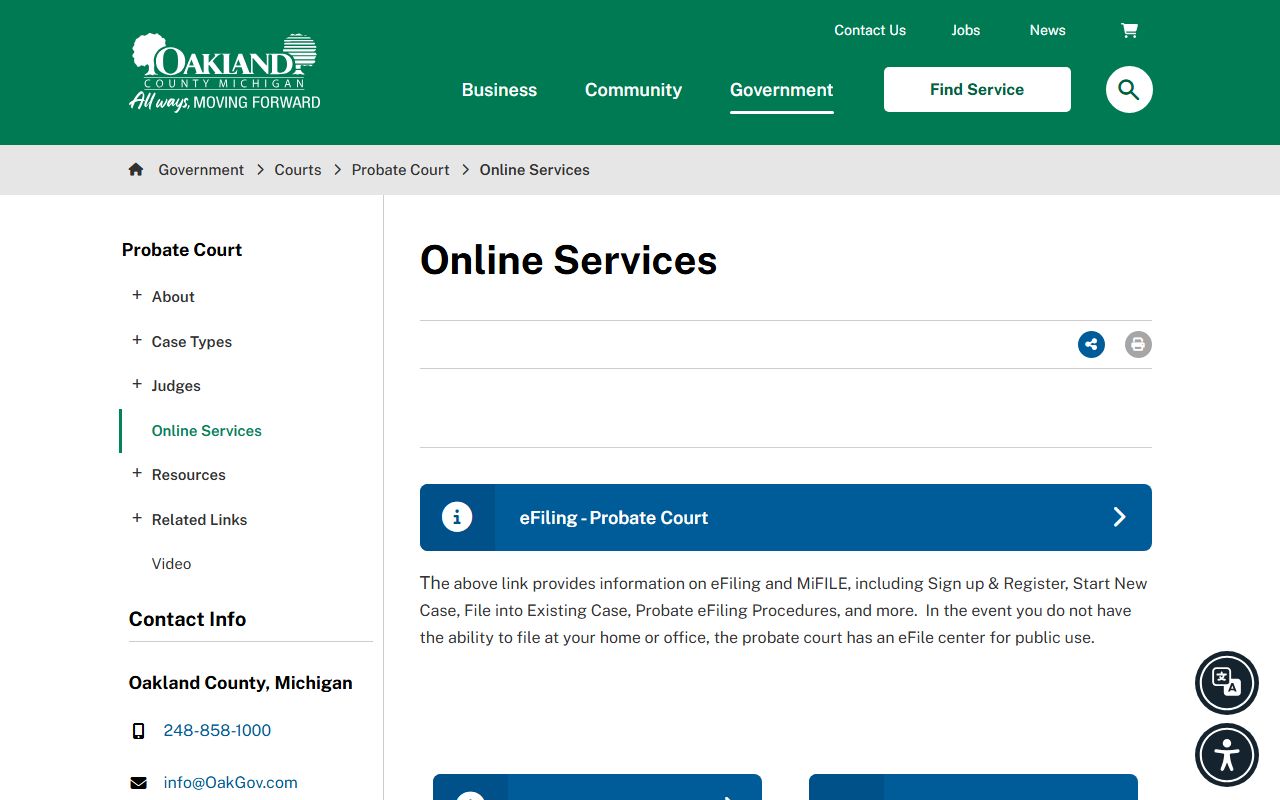
When only a party name is known, Probate Access supplies the case number needed to place an online copy order.
E-Filing Rules for Oakland County Probate Cases
Filing at the Probate Court changed on June 12, 2025. As of that date, filers submitting documents to the court must e-file through the MiFILE system under MCR 1.109(G)(3)(f). With few exceptions, the court no longer accepts documents for filing in person, by fax, or by mail. This shift affects anyone opening an estate, answering a guardianship petition, or adding to an existing case.
The court set up an eFile center for public use so that people without a home or office computer can still file. That option matters for self-represented filers who need to meet the electronic requirement. Searching and ordering copies of existing records stays separate from filing, so a member of the public looking up a case does not need a MiFILE account.
The rule reflects a wider move toward electronic court records in Michigan. Filers should confirm the narrow exceptions with the court before assuming a paper filing is allowed. New estates, guardianship petitions, and later documents in an open case all fall under the electronic requirement.
What Oakland County Probate Records Show
A probate case file builds a full picture of how an estate or protected arrangement is handled. Estate files can hold the will, the petition to open the estate, letters of authority for the personal representative, the inventory of assets, accountings, and orders of distribution. Guardianship and conservatorship files can hold the petition, the order appointing the guardian or conservator, and periodic reviews. Probate Access shows case status and general information, but the underlying documents come from the court.
Each entry ties back to a case number, the assigned judge, the party names, and the filing dates. The register of actions lists events in order, which helps a reader follow the case from opening to closing. Copies of the actual filings still require an order by case number or a visit to the court.
The court's online services also include an inventory fee calculator and Judicial Schedule Online, where users check court dates by date, judge, or bar number. These tools help estate representatives plan filings and track hearing dates. They do not replace the case file, which stays the official source for what the court decided.
Restricted Probate Records
Not every probate matter is open to the public. Mental health proceedings are protected and are excluded from the county's general online case tools. Records tied to protected personal identifying information are separated from public filings, and some guardianship material may be limited depending on the case. Probate Access itself states that nonpublic information is not available through the search.
When a record is restricted, a name match in the online tool does not open the file. Access to protected matters generally requires proper legal standing or a court order. For ordinary estate and guardianship status, the public tools work well, but sensitive categories route through the court under Michigan court rules.