
Criminal Court Records in Oakland County
A criminal court record is the full case file the court keeps once charges are filed against a defendant. The file starts on the day a complaint or warrant is authorized. It grows as the case moves, and it stays with the court after the case ends. For felony cases in the Sixth Judicial Circuit Court, the Oakland County Clerk/Register of Deeds Legal Records Division records and maintains these files. Legal Records handles civil, domestic, felony criminal, and business court files for the circuit. The register of actions, the charging papers, the plea documents, and the sentencing orders all live inside that case file.
Two trial-court levels produce criminal records here. District courts handle misdemeanor cases, felony arraignments, and preliminary examinations. The Circuit Court handles felony cases after a district court sends them up. So a single serious case may leave a trail in both a district court and the Circuit Court. A closer look at the specific charges filed after an arrest lives in the Oakland County arrest records and court charges page, while every other case type is covered under general Oakland County court records.
How to Search Oakland County Criminal Court Records
Felony criminal records for the Sixth Circuit are searched through Court Explorer, the county portal for public legal records. The county page confirms that cases can be looked up by name or by case number and that felony criminal case types are covered. Court Explorer shows primary party information, the register of actions, and options to order copies of documents filed on a case. The county is clear that Court Explorer is not the official record and should not be used as a criminal background check.
- Open Court Explorer for Sixth Judicial Circuit public legal records.
- Search by the defendant name or by the case number if you have it.
- Narrow the results by case type and filing date to find the right file.
- Open the case to read the register of actions, the charges, and the disposition.
- Order a certified copy from the Legal Records Division when an official document is needed.
Misdemeanor and preliminary felony records often sit in a local district court rather than the Circuit Court. The state MiCOURT Case Search covers participating district and probate courts, and the case types shown vary by the court searched. For a broader criminal history, the Sheriff's Records Unit directs people to the Michigan State Police rather than treating any case portal as a background check.
Stages of an Oakland County Criminal Case
A Michigan felony moves through set stages, and each stage leaves a mark in the record. The case usually begins in a district court after the prosecutor authorizes a complaint and warrant. It then passes to the Circuit Court for trial-level work if the charge survives the early hearings. Misdemeanor cases stay in the district court from start to finish. Reading the stages helps you place each docket entry in order.
Felony case flow: Complaint and Warrant (District Court) › Arraignment › Preliminary Examination › Bindover › Circuit Court Arraignment › Pretrial and Motions › Plea or Trial › Sentencing
| Stage | What Happens |
|---|---|
| Arraignment | The defendant is told the charges and enters a first plea. Bond and release terms are set in the district court. |
| Preliminary Examination | A district court judge tests whether there is probable cause to send a felony up to the Circuit Court. |
| Bindover | The felony is transferred from the district court to the Circuit Court for trial-level proceedings. |
| Pretrial and Motions | Lawyers file motions, exchange information, and discuss a plea. Hearing dates are added to the docket. |
| Plea or Trial | The defendant pleads, or a judge or jury decides guilt after trial. |
| Sentencing | The court imposes punishment, which can include jail, prison, probation, fines, or restitution. |
Note: A felony that is not bound over can be dismissed or reduced at the district level, so the record may end long before it reaches the Circuit Court.
What an Oakland County Criminal Court Record Shows
A criminal case file collects the same core fields across most Michigan courts. Court Explorer supports primary party information, the register of actions, and document copy orders for circuit felony files. District records in MiCOURT may show the court, the parties, the case, and event information based on the local court's data feed. The table below breaks down the fields a searcher is most likely to read.
| Field | What It Shows |
|---|---|
| Case Number | The unique file number the court assigns to the case. |
| Defendant | The person charged, named as the party the state prosecutes. |
| Charges | Each offense as filed, tied to a Michigan statute and a severity level. |
| Register of Actions | The dated list of every filing, motion, hearing, and order in the case. |
| Plea | The defendant's formal answer, such as guilty, not guilty, or no contest. |
| Disposition | The outcome of each charge, from dismissal to conviction. |
| Sentence | The punishment imposed, including jail, probation, fines, or restitution. |
Some data is held back by rule. Michigan court forms use the MC 97a addendum to separate protected personal identifying information from public filings. The county also notes that courts are barred from posting document images to the public internet under MCR 8.119(H), so many files show the docket while the actual images stay at the courthouse.
Charges vs. Convictions
A charge and a conviction are not the same thing, and a criminal court record can show both. A charge is an accusation that starts the case. A conviction is a finding or plea of guilt at the end. Many charges never become convictions. They can be dropped, dismissed, reduced, or end in a not-guilty verdict. Reading a record without this distinction can badly mislead.
| Charge | Conviction | |
|---|---|---|
| Stage | Accusation | Verdict or plea |
| Burden of Proof | Probable cause | Beyond reasonable doubt |
| Public Record | Yes | Yes |
Reading Dispositions in Oakland County Criminal Records
The disposition is the outcome the court records for each charge. Common results include guilty, not guilty, dismissed, and no contest. A charge may be dismissed with prejudice, which usually means it cannot be refiled, or without prejudice, which leaves the door open. Some cases end in a plea to a lower charge, so the disposition may not match the charge as first filed.
The sentence follows a conviction and sits beside the disposition in the file. It can list a jail or prison term, probation supervision, fines, court costs, and restitution to a victim. Probation orders and post-judgment motions can keep a file active long after sentencing. A recent Circuit Court news item described a felony animal-neglect sentencing that followed a conviction involving twenty-five or more animals, a plain example of how a plea or verdict leads to a sentencing order in the record.
Oakland County Prosecutor Divisions
The Oakland County Prosecutor, Karen D. McDonald, leads the office that brings criminal cases and shapes what appears in the record. The office splits its work into divisions, and each one leaves a different footprint across district and circuit files. Understanding which division touched a case helps explain the charges and the court level in the record.
The way the office is organized is laid out on the county's Prosecutor divisions and units page.
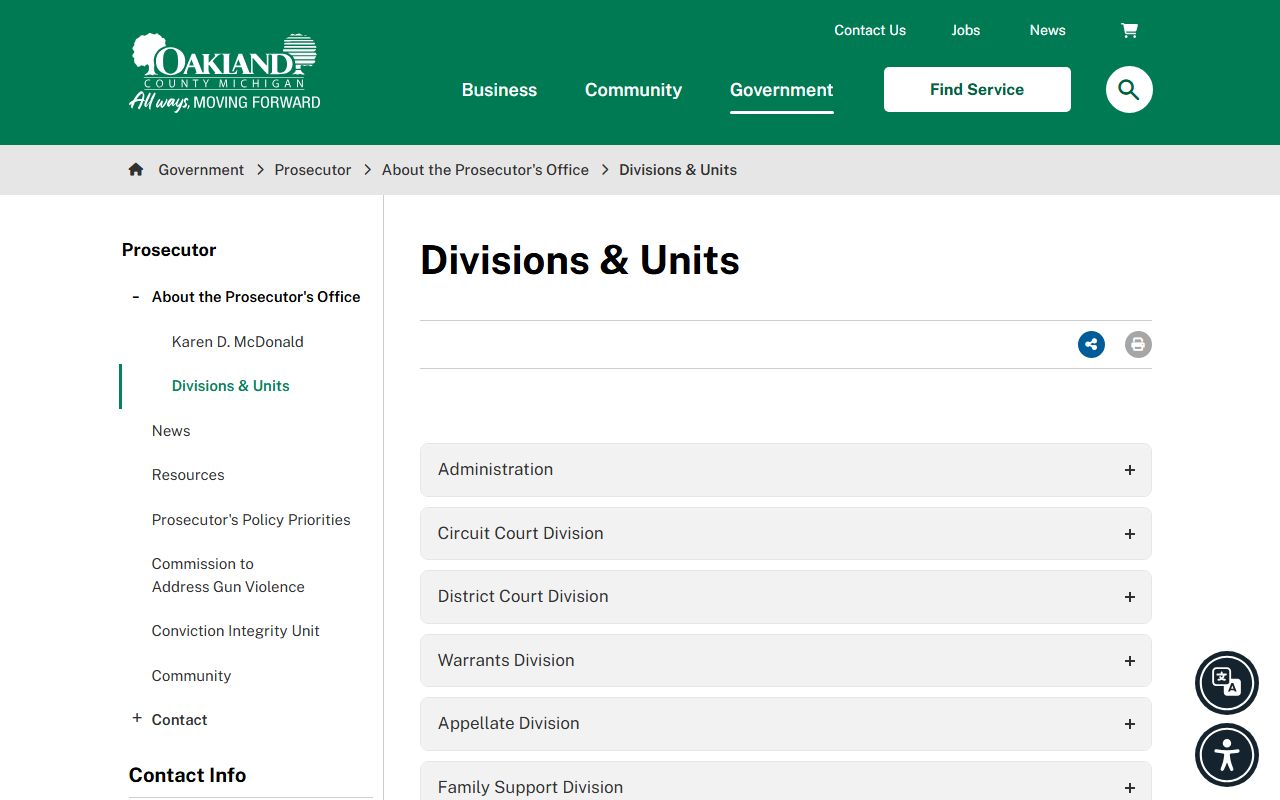
The division layout shown there maps neatly onto the criminal record trail in Oakland County.
- Circuit Court Division: Prosecutes felony cases not assigned to a special unit, including home invasion, robbery, assault, felony drunk driving, and homicide.
- District Court Division: Handles cases before 15 district courts and about 30 district judges, roughly 50 dockets each week, plus preliminary examinations and misdemeanors.
- Warrants Division: Reviews police investigations and authorizes the complaints and warrants that open a case.
- Appellate Division: Handles criminal and child-protection appeals in the Circuit Court, the Court of Appeals, and the Michigan Supreme Court.
- Family Support Division: Establishes paternity and support and prosecutes repeated failure to pay support.
Defendants who cannot afford a lawyer may be represented through the county's Indigent Defense Services Office. The office was created in October 2021 to comply with MIDC Standard 5, which requires attorney appointments to be managed apart from the judiciary. Appointed-counsel activity often appears in the register of actions as a case moves forward.
Specialty Courts in Oakland County Criminal Cases
Not every criminal case ends in standard sentencing. Oakland County runs several problem-solving courts that offer supervised treatment instead of a straight jail term. These programs leave their own entries in the record, such as program admission, phase progress, and completion. They aim to promote accountability, support recovery, and cut future justice-system involvement.
The Circuit Court Adult Treatment Court serves nonviolent felony offenders with substance use disorders and co-occurring mental health diagnoses. Details on the program appear on the county's Adult Treatment Court page.
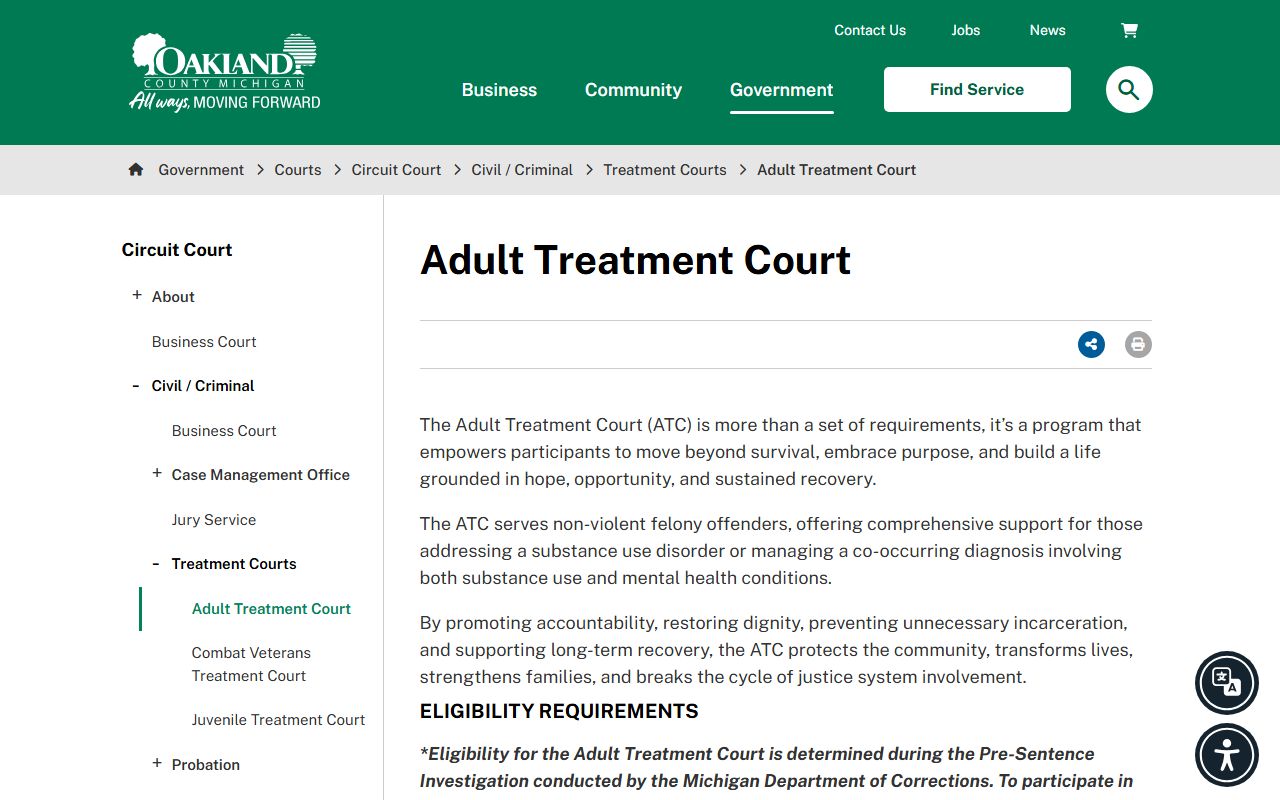
The program uses intensive court supervision and counseling across four stages, with Stage 1 lasting 16 weeks and later stages at least 12 weeks each.
A separate track serves those who served in uniform. The Circuit Court Combat Veterans Treatment Court helps eligible U.S. military veterans meet probation terms through judicial oversight, mentoring, mental health and substance-abuse treatment, and readjustment counseling. The program details are posted on the Combat Veterans Treatment Court page.
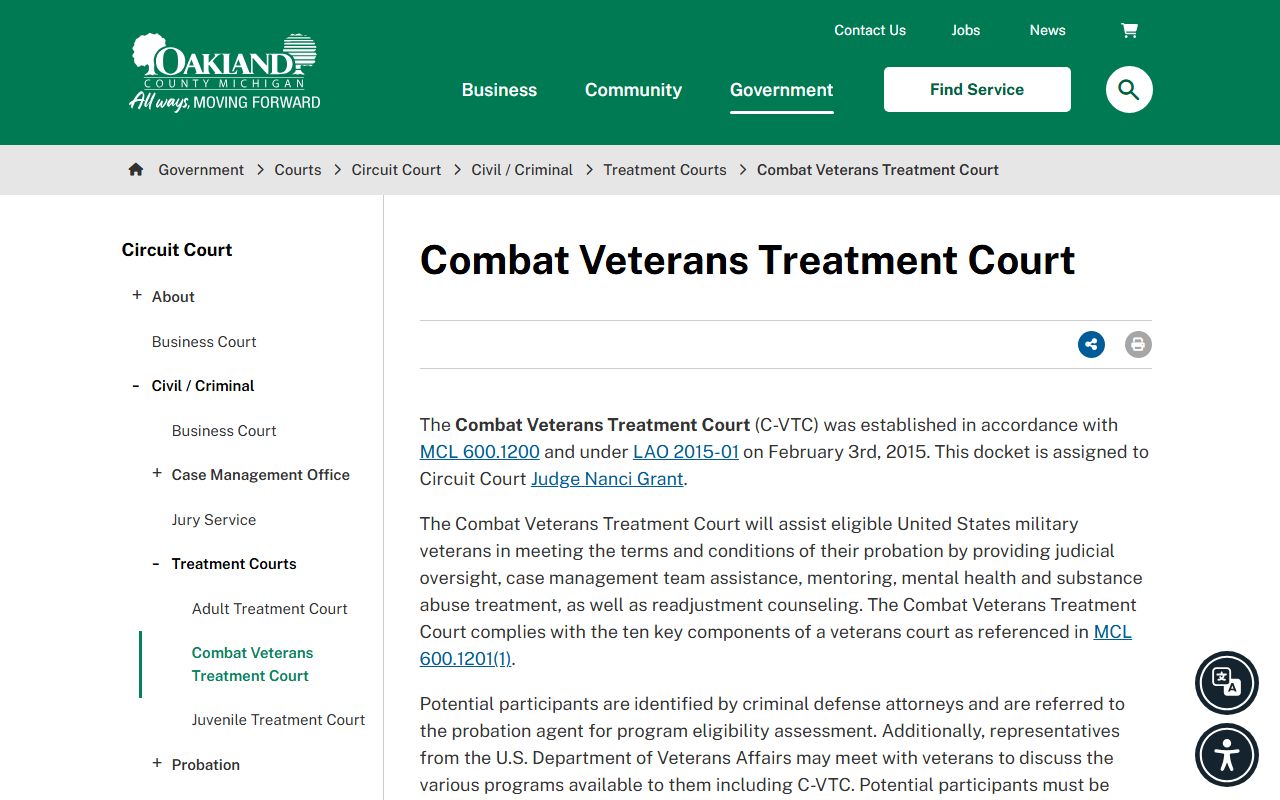
The county says the veterans program follows the ten key components referenced in MCL 600.1201(1). District courts run their own tracks too, including Sobriety Court, Mental Health Court, and Veterans Treatment Court in the 52-2 and 52-3 divisions.
Sealed vs. Set Aside Criminal Records
Michigan does not use the word "expunged" the way many states do. The state term is "set aside," which makes an eligible conviction nonpublic for most public searches. A sealed record is hidden by statute or court order. A set-aside conviction stays in law-enforcement systems but drops off the public-facing record. Both routes remove a case from ordinary public view, but they work through different rules.
| Sealed | Set Aside | |
|---|---|---|
| Visibility | Hidden from public access | Nonpublic for most public searches |
| Law Enforcement | Limited access by rule | Retained access as allowed by statute |
| Eligibility | By statute or specific court order | Under MCL 780.621 through 780.621d |
The county's set-aside page says that if sentencing happened at the Sixth Judicial Circuit Court, the Application to Set Aside Conviction must be filed with the Oakland County Clerk's Office. The SCAO MC 227 form tells applicants to confirm eligibility, file in the court where the conviction occurred, and use a separate application for each court, with special forms for human trafficking victim convictions and misdemeanor marijuana convictions.
Public Access to Oakland County Criminal Records
Criminal case files are generally public, but the path to them runs through the court, not a generic records request. Michigan's Freedom of Information Act favors access to public records, yet it excludes the judiciary from the definition of a public body. That means the correct route for a court file is the court or the clerk that owns it. Court rules, not FOIA, control criminal case access in Oakland County.
Key Statutes:
MCL 15.232 - Defines a public record and excludes the judiciary, including the county clerk acting as circuit-court clerk, from FOIA's public-body rules.
MCR 8.119 - Governs court-record access and retention and limits public internet access to document images.
Background Check Considerations
A casual name search and a formal background check are very different tools. Court Explorer and MiCOURT can help you read a specific case, but neither is a certified criminal history. The Sheriff's Records Unit points people who need a broad search to the Michigan State Police. Employers and landlords who rely on criminal records must follow the federal and state rules that govern regulated screening.
Important: This site is not a consumer reporting agency under the Fair Credit Reporting Act, and its information may not be used for credit, employment, tenant, or insurance decisions.
Restricted Oakland County Criminal Records
Some criminal and related records are closed to the public even when a case exists. Juvenile cases are restricted, so online access should not be assumed. Personal Protection Orders are excluded from Court Explorer, and probate mental health records are also kept out of that portal. Sealed and set-aside convictions may no longer appear in a public search at all.
Protected personal identifiers add another layer. Social Security numbers, financial account data, and minor identifiers should not appear in public document images, and the MC 97a addendum keeps them separate from the public file. When a record is restricted, the correct route is the court with proper standing or a court order, not a third-party site. Active warrants and current custody status sit outside the case file, so they are tracked through the Sheriff's warrant resources and the county jail roster rather than the criminal case index.